
If you have ever looked at an RV specification sheet and felt overwhelmed, you are not alone. RV weight ratings are some of the most important numbers to understand before buying or towing an RV, yet they are also some of the most confusing for RV buyers and owners.
To make matters more confusing, manufacturers do not always present weight information in the same way. Some numbers are estimates or averages, and in some cases, manufacturers may use definitions that differ from what is commonly understood across the industry. In other instances, a manufacturer may list the Gross Vehicle Weight Rating and Cargo Carrying Capacity, but not clearly publish the Unloaded Vehicle Weight, requiring that number to be calculated.
At Jerry’s RV, we believe customers deserve clear, consistent information. That is why we use the same definitions for RV weight-related terms every time. Even when a manufacturer uses alternate terminology, estimated values, or calculated figures, we rely on consistent definitions so our customers can compare RVs fairly and confidently—true apples to apples.
Why RV Weight Ratings Matter for Safety and Towing
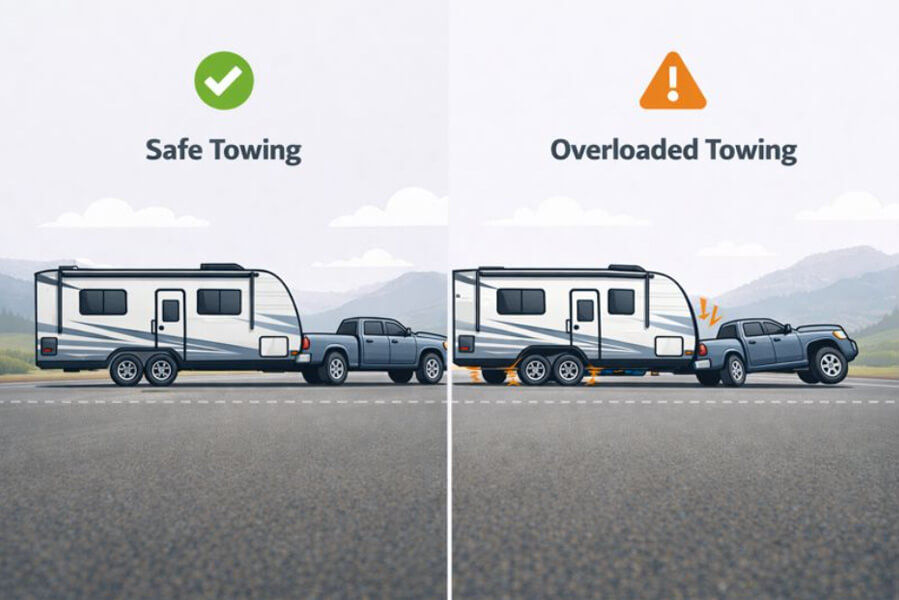
RV weight ratings play a critical role in safety, towing performance, and long-term reliability. They affect how your RV tows, stops, and handles on the road. They also determine whether your tow vehicle is properly matched to the RV and help prevent unnecessary strain on tires, axles, suspension, and braking systems.
Understanding RV weight ratings helps avoid overloading, improves towing stability, and reduces the risk of mechanical issues or unsafe towing situations.
Key RV Weight Terms Every RV Owner Should Know
Gross Vehicle Weight Rating (GVWR)
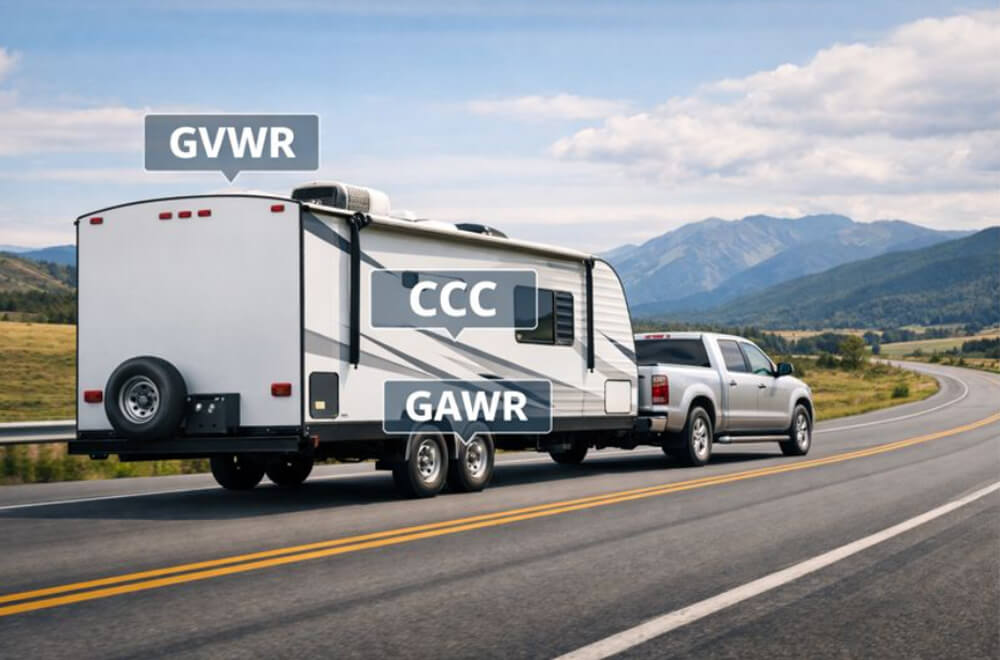
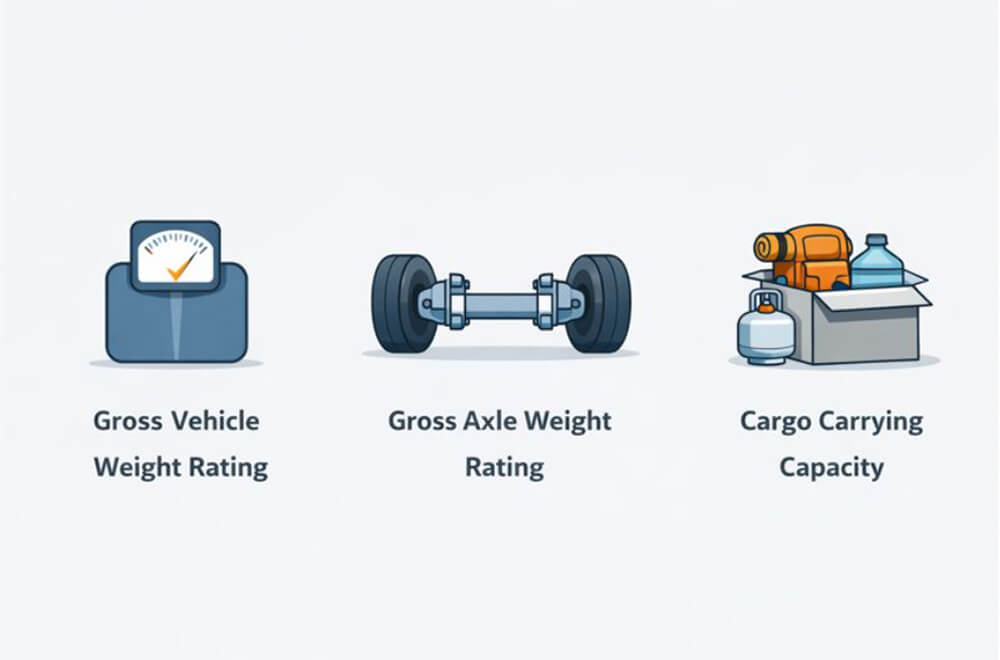
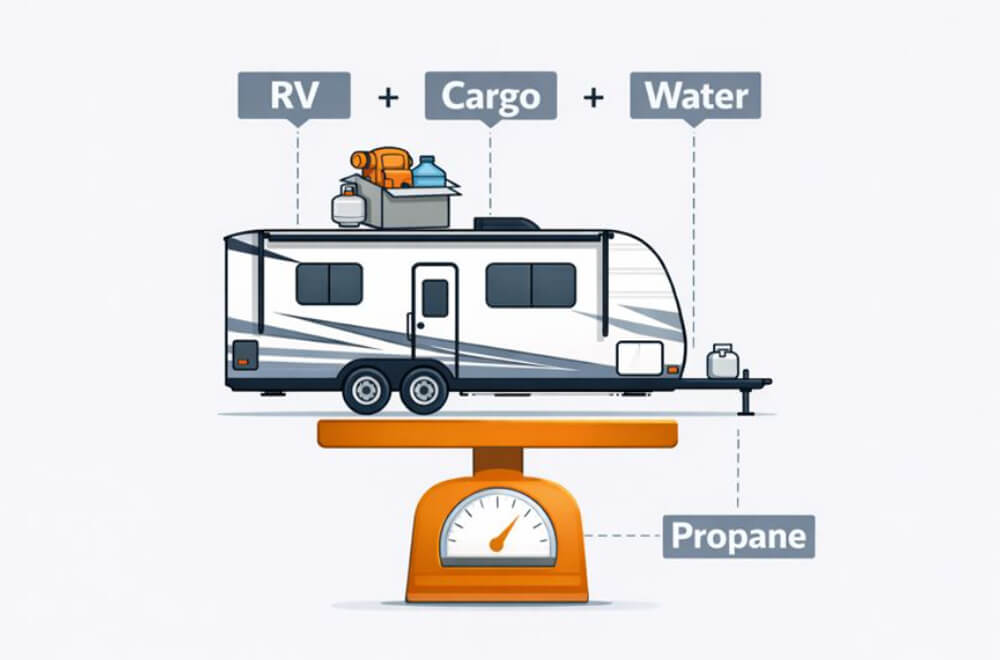
The Gross Vehicle Weight Rating is the maximum allowable weight of the RV when it is fully loaded and ready for travel. This includes the weight of the RV itself along with all cargo, fluids, propane, optional equipment, and accessories.
This number should never be exceeded. Staying at or below the GVWR is essential for safe operation, proper handling, and long-term durability.
Gross Axle Weight Rating (GAWR)
The Gross Axle Weight Rating (GAWR) is the maximum amount of weight that each individual axle of the RV can safely support.
Even if the RV is within its GVWR, improper weight distribution can overload an axle. This is why how you load your RV is just as important as how much you load.
Cargo Carrying Capacity (CCC)
Cargo Carrying Capacity is the amount of weight your RV can safely carry inside and on the RV. This includes personal cargo, optional equipment, accessories, fresh water, and the contents of the black and gray tanks.
Cargo Carrying Capacity is determined by comparing the RV’s Gross Vehicle Weight Rating to its true Unloaded Vehicle Weight. The difference between those two numbers represents how much weight can be safely added without exceeding design limits.
Because Unloaded Vehicle Weight can vary from unit to unit based on factory-installed options, Cargo Carrying Capacity can also vary—even among RVs of the same model. This is why using the actual UVW for a specific RV provides the most accurate picture of how much cargo capacity is available.
Fresh water weighs approximately 8.3 pounds per gallon, so filling the fresh water tank can significantly reduce remaining cargo capacity. Understanding how these weights add up helps ensure the RV is loaded safely and within limits.
Understanding Tow Vehicle Capacity and Trailer Weight
In addition to understanding RV weights, it is just as important to understand what your tow vehicle can safely handle.
Your tow vehicle’s towing capacity is the maximum towing capacity established by the vehicle manufacturer and is based on factors such as engine size, transmission, cooling systems, axle ratios, suspension, and braking capability.
The most reliable place to find your vehicle’s towing capacity is in the owner’s manual or by checking directly with the vehicle manufacturer or dealership. These sources provide towing ratings specific to your exact vehicle configuration.
Online towing guides and averages can be helpful during early research, but they do not always account for important variables such as drivetrain, engine options, factory-installed towing packages, or aftermarket modifications. Because of this, online numbers may not accurately reflect what your specific vehicle can safely tow.
When shopping for a trailer, we recommend leaving a reasonable margin between your vehicle’s maximum towing capacity and the trailer’s Unloaded Vehicle Weight.
For example, if a vehicle has a maximum towing capacity of 3,500 pounds, we often recommend looking at a trailer with an Unloaded Vehicle Weight between 2,500 and 3,000 pounds. This leaves between 500 and 1,000 pounds of margin and makes it easier to stay within safe limits once the trailer is loaded for travel.
This approach improves towing stability, reduces strain on the vehicle, and provides a more comfortable and confident towing experience.
Payload, Tongue Weight, and How Manufacturers Define Towing Limits
When matching an RV to a tow vehicle, towing capacity is only part of the picture. Payload and tongue weight are just as important, and vehicle manufacturers do not all define towing limits the same way.
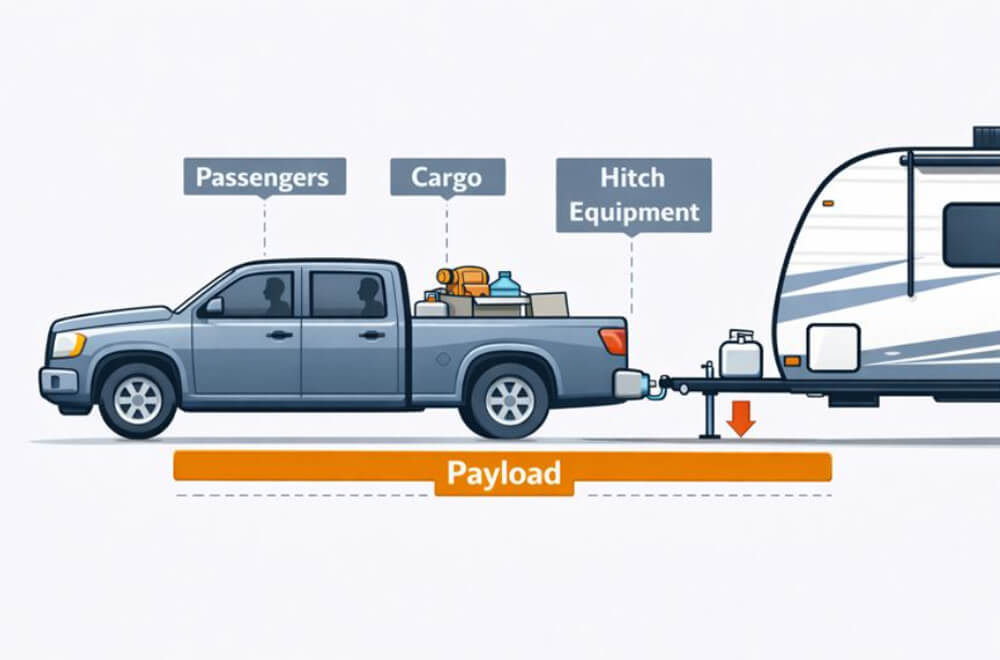
Payload is how much weight your tow vehicle can safely carry on and in the vehicle itself. This includes passengers, cargo inside the vehicle, hitch equipment, and the tongue weight of the trailer. The most accurate payload rating is typically found on the sticker inside the driver’s door jamb and in the owner’s manual.
Tongue weight is the portion of the trailer’s weight that presses downward on the hitch of the tow vehicle. For most travel trailers, tongue weight typically falls between 10 and 15 percent of the trailer’s loaded weight.
For example, a trailer that weighs 3,000 pounds when loaded will usually have a tongue weight between 300 and 450 pounds.
Tongue weight always counts against payload. Even if a vehicle can tow a trailer’s total weight, exceeding payload limits due to passengers, cargo, hitch equipment, or tongue weight can still create unsafe towing conditions.
Some manufacturers publish a single maximum towing capacity based on a lightly loaded vehicle. Others require towing limits to be calculated based on remaining payload after accounting for passengers, cargo, hitch equipment, and tongue weight.
Both approaches are valid, but they must be interpreted correctly. Ignoring payload-based limits can result in overloading even when the advertised towing capacity appears sufficient.
Because towing capacity, payload, tongue weight, hitch equipment, and wiring all work together, these decisions are rarely one-size-fits-all.
At Jerry’s RV, we have a towing and wiring specialist who is happy to discuss these factors with any customer or potential customer. Whether you are selecting a trailer, reviewing your tow vehicle, or determining the right hitch and wiring setup, our goal is to help make sure everything works together safely and comfortably for your camping needs.
Taking the time to look at the full picture helps ensure you are considering the right trailer and the right towing equipment—not just what works on paper, but what works for how you actually camp.
Real-World RV Weights Matter
RV load capacity is determined by weight, not by available storage space. Just because an item fits in a storage compartment does not mean it is safe to carry.
In some situations, it is possible to approach weight limits even when storage space is still available, which is why understanding real-world weights is important.
Jerry’s RV Commitment to Clear and Consistent Weight Information
Some manufacturers rely on estimates, calculations, or define RV weight terms differently, which can make comparisons difficult.
At Jerry’s RV, we focus on clarity and consistency. We use real-world RV weights whenever possible and clearly identify when a number is actual, calculated, or estimated. Our goal is to help you understand exactly what the numbers mean so you can make informed, confident decisions—without surprises.
Before You Tow: A Quick Checklist
Before finalizing an RV purchase or heading out on a trip, it helps to review a few key items:
- Confirm your vehicle’s towing capacity using the owner’s manual or manufacturer specifications
- Check the payload rating on the driver’s door sticker
- Confirm whether your vehicle is equipped with a factory-installed towing package and understand what it includes
- Understand how passengers, cargo, hitch equipment, and tongue weight affect payload
- Leave a reasonable margin between towing capacity and trailer weight
- Ask questions if any numbers seem unclear
Frequently Asked Questions
What is Unloaded Vehicle Weight (UVW)?
Unloaded Vehicle Weight is the weight of an RV as it leaves the factory before any personal cargo, fresh water, or dealer-installed accessories are added. It includes the RV’s structure, axles, tongue or pin weight, LP gas, and all factory-installed options.
Why do I see different Unloaded Vehicle Weight (UVW) numbers online?
The UVW listed online or in manufacturer brochures is often an estimated average. This number is based on a standard build and common factory configurations for that model.
Is there a more accurate UVW for the actual RV on the lot?
Yes. Many RVs include a factory weight sticker attached to the unit. All Coachmen and Palomino models we carry include this sticker.
Which UVW does Jerry’s RV use on its website?
Whenever an actual factory weight sticker is available, Jerry’s RV uses that specific unit’s UVW. If a sticker is not available, we clearly identify whether the UVW is calculated or estimated.
What if a manufacturer does not provide an actual weight sticker?
If a manufacturer lists GVWR and CCC but does not list UVW, the UVW can be calculated by subtracting CCC from GVWR. If an exact weight cannot be determined, we clearly note that the UVW shown is an estimate. When possible, we may also weigh the RV on a federally inspected scale.
What counts toward Cargo Carrying Capacity (CCC)?
Cargo Carrying Capacity includes all weight added to the RV beyond its Unloaded Vehicle Weight.
This includes:
- Personal cargo and camping gear
- Optional equipment and accessories
- Fresh water in the fresh tank
- Waste held in the black and gray tanks
- Any items stored inside or on the RV
Understanding what counts toward CCC helps ensure the RV is loaded safely and remains within its weight ratings.
How much towing margin should I plan for when choosing a trailer?
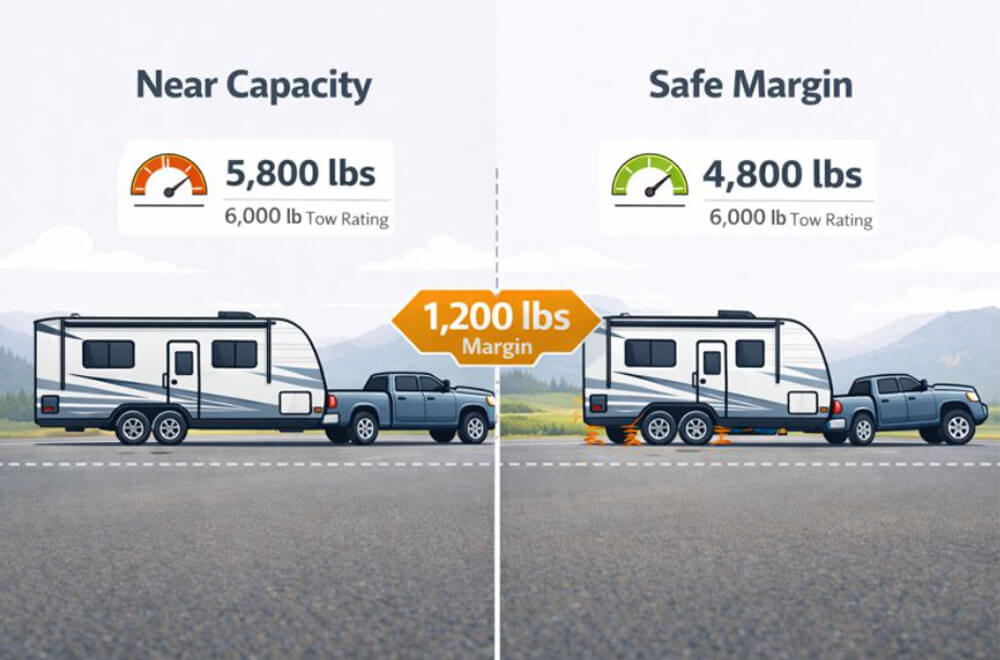
While every vehicle and camping style is different, it is generally wise to leave a reasonable margin between your vehicle’s maximum towing capacity and the trailer you choose.
For example, if a vehicle has a maximum towing capacity of 3,500 pounds, we often recommend looking at a trailer with an Unloaded Vehicle Weight between 2,500 and 3,000 pounds. This leaves between 500 and 1,000 pounds of margin and makes it easier to stay within safe limits once the trailer is loaded for travel.
Planning this margin helps account for cargo, fluids, tongue weight, and real-world driving conditions, and typically results in a more stable and comfortable towing experience.
How do payload and tongue weight affect towing?
Payload includes passengers, cargo, hitch equipment, and tongue weight. Tongue weight is part of payload. Exceeding payload limits can create unsafe towing conditions even if the trailer’s total weight is within towing capacity.
Final Takeaway
At Jerry’s RV, our goal is simple: clear numbers, consistent definitions, and no surprises.